Psychedelic Integration
FOR PEOPLE WHO HAVE SEEN SOMETHING — AND NEED HELP UNDERSTANDING WHAT IT MEANS.
You’ve had an experience.
Maybe it was psilocybin. MDMA. Ayahuasca. Ibogaine. Ketamine. Maybe it was something you can't fully put into words — or a moment where the ordinary boundaries of your identity dissolved and something larger came through.
Now you're back in your regular life, with your regular problems —except something shifted and you don't quite know what to do with it.
Or maybe you haven't had the experience yet but you're curious. You've read the research. You've heard the stories. You know something is there — and you want to go in prepared, not just hopeful.
Either way — you're in the right place.
Psychedelic experiences don't heal you —they open doors.
Psychedelic experiences don't heal you —they open doors.

Why integration matters.
Psychedelic Experiences don’t heal you. They open doors.
What happens after the experience matters just as much as the experience itself, and that can require support from someone who understands both the experience and the territory it's pointing toward.
Without integration, profound experiences can become destabilizing. Sometimes the insights fade, the old patterns may reemerge and the door feels like it has closed again. People sometimes describe feeling worse after a powerful experience — not because something went wrong, but because nothing helped them process what came up.
Integration is the work of landing it, making meaning from the experience, and letting it change you in a way that actually sticks.
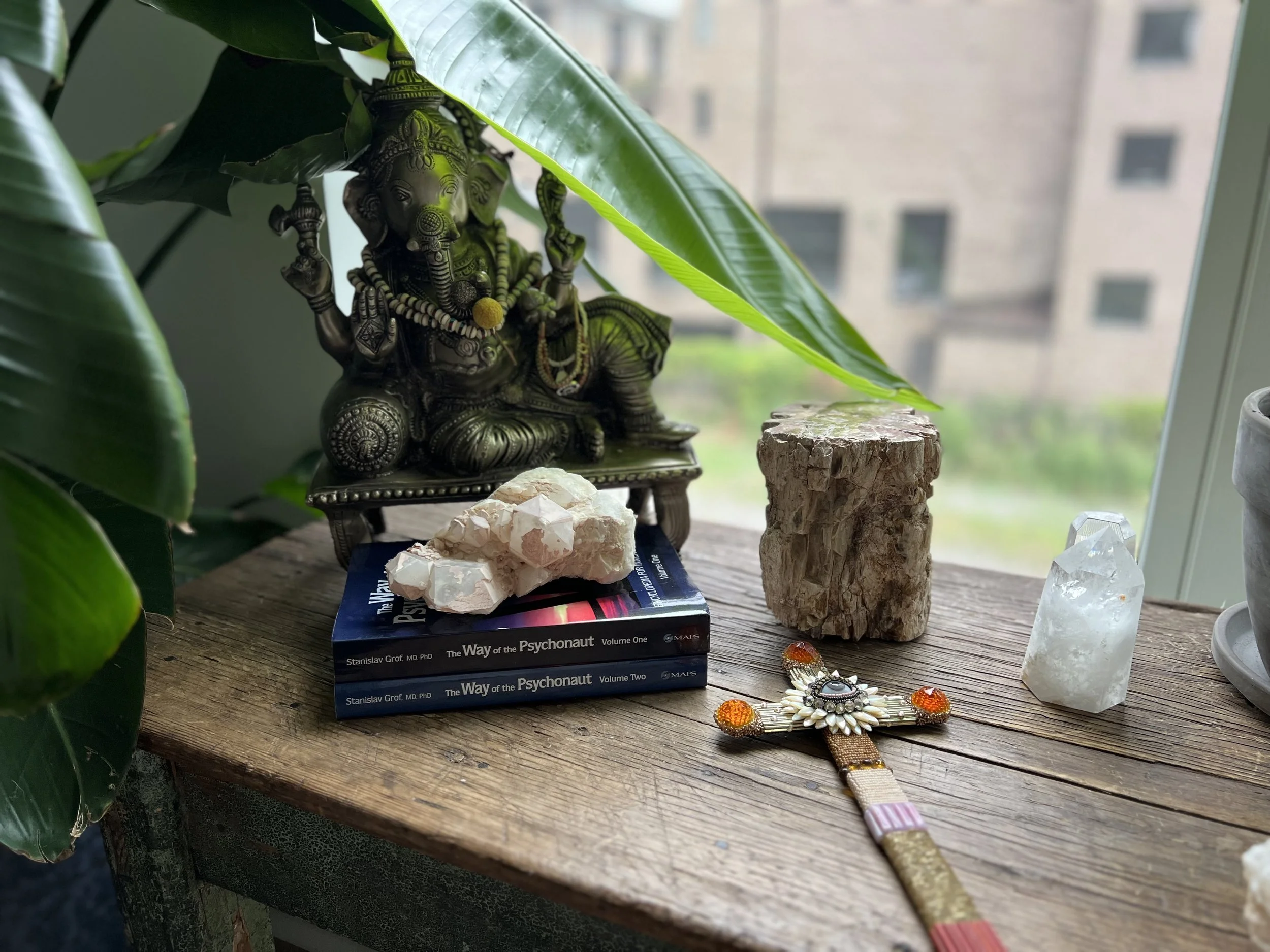
Why this work needs a different container.
Psychedelic experiences can bring up questions that don't always fit neatly into ordinary conversation — questions about identity, consciousness, spirituality, meaning, death, connection, or experiences that feel mystical or difficult to explain.
My approach draws on transpersonal perspectives, contemplative and spiritual traditions, and my work as an ordained minister and spiritual counselor. That gives us room to explore the symbols, imagery, archetypes, questions, and experiences that emerged without needing to immediately decide what they mean.
What integration looks like with me.
There's no separate protocol here.
This work lives inside the same container I use with every client — because real integration isn't something that happens in a session. It's how your life changes as a result of what you experienced.
We work directly with what came up. The symbols. The colors and imagery. The archetypes. The encounters. The moments that felt crystalline — and the ones you still don't have language for. Nothing gets reduced or pathologized. Nothing is off the table.
The questions we're always asking are the same: what did it show you, what needs to be grounded, and what changes now?
What this looks like practically.
Psychedelic preparation and integration take place within my three-month REALIGN™ Private Engagement.
You’ll move through six 90-minute sessions — two sessions each month — with the work structured around the experience itself.
Month One · Preparation
The month before your experience is about preparing the whole person — biologically, psychologically, and spiritually.
Depending on the medicine, retreat, or experience, we may work with dietary preparation, sleep and daily rhythms, supplements or herbs, nervous system support, intention, expectations, fears, emotional patterns, spiritual beliefs, and anything else you’re bringing into the experience.
Month Two · The Experience
During the month of your experience, our two sessions create space for both preparation and early integration.
We work with what’s happening as you approach the experience and, afterward, begin exploring what actually occurred — the imagery, emotions, insights, questions, confusion, or spiritual experiences that emerged.
Month Three · Integration
The month afterward is about helping the experience land in your actual life.
We revisit what came up, explore what still feels unresolved or significant, and look at how the experience may be affecting your relationships, patterns, identity, health, and the way you understand yourself.
Your broader REALIGN™ protocol continues throughout, so integration may also include nutrition, sleep, daily rhythms, lab work when relevant, nervous system support, spiritual practice, and other recommendations based on what you need.
The experience may happen in a day. Integration is what happens when you bring it back into your life.
Want to go deeper into the research and history behind this work? Read: Why Psychedelic Integration Matters — and Why Transpersonal Counseling Is the Right Home for It

The Lucia Light — Non-Ordinary States Without Substances
You don't necessarily need a substance to access non-ordinary states of consciousness. Chanting, meditation and breath work have been just a few of the tools that have been used for thousands of years.
The Lucia Light is one of the tools that I use in my practice. It is neurological light device that uses pulsed light to entrain the brain into deep meditative states — creating a sober, technology-assisted experience that produces many of the same conditions for expanded awareness, emotional release, and contact with the deeper self.
For people in recovery, those not ready for plant medicine, or anyone wanting to explore non-ordinary states safely — the Lucia Light offers a powerful entry point. And for those preparing for or integrating a psychedelic experience, it's an extraordinary bridge.
Think you might be ready for psychedelic integration?
This work is for you if…
✔ You've had a psychedelic experience and don't know how to integrate what came up
✔ You're preparing for an experience and want to go in with intention and support
✔ You're in recovery and curious about plant medicine but navigating the complexity of that
✔ You've had a spiritual experience — with or without substances — that you haven't been able to make sense of
✔ You want access to non-ordinary states without substances
✔ You're a veteran, first responder, or someone carrying trauma that conventional treatment hasn't been able to support
✔ You know the healing you're looking for isn't in a diagnosis or a prescription — it's in something deeper